
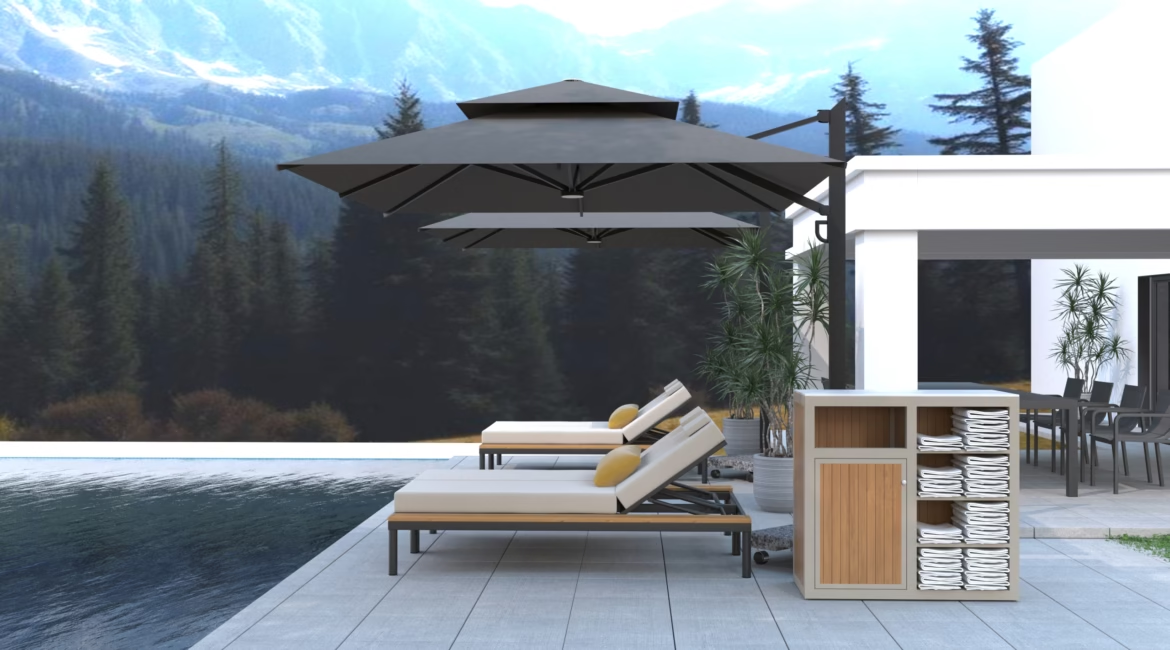
A patio umbrella failure rarely starts with fabric. It starts with a spec that did not match the site – a windy rooftop treated like a calm courtyard, a cantilever placed where staff need quick reset, or a base that looked fine on paper but could not hold up once guests began moving chairs. For real peace of mind, it’s important to choose Commercial Patio Umbrellas That Last on Site so you avoid these common pitfalls.
If you are procuring shade for restaurants, hotels, pool decks, or multi-site developments, commercial outdoor umbrellas for patios are not an accessory. They are infrastructure. They affect layout density, service speed, guest comfort, and replacement cycles. The goal is simple: build a shade plan that looks intentional on day one and stays operational through heat, UV, and real use.
What “commercial” should mean in outdoor umbrellas
In project work, “commercial” should translate into measurable performance and predictable support. You want frames that hold alignment, fabrics that retain color, hardware that is serviceable, and a vendor that can deliver consistent specs across dozens or hundreds of units.
It also means the umbrella is designed for the way hospitality teams actually use shade. Staff open and close it daily. Guests bump it with chairs. Wind funnels through corridors. Chlorine and salt air attack finishes. If the product is not built for that cycle, the patio becomes a maintenance ticket.
Start with the site, not the shape
Most umbrella decisions are made from a rendering. That is useful, but the correct starting point is the site conditions that will punish the product.
Wind is the first filter. Rooftops, coastal terraces, and urban canyons create gust patterns that will stress ribs and tilt mechanisms. In these environments, a center-pole with a properly sized commercial base is often easier to manage than a large cantilever, because it tends to have fewer moving parts and faster close-down when weather shifts.
Sun exposure is next. High UV regions do not just fade fabric – they also heat hardware and accelerate wear in plastic components. Spec fabrics and finishes with UV stability as a requirement, not a preference.
Finally, map circulation. If servers need to pass between tables, a center pole can become a nuisance. If guests frequently reconfigure seating, cantilevers can create a cleaner footprint. There is no universal best choice – only the best choice for your traffic pattern.
Choosing the right type: center-pole vs cantilever
Center-pole umbrellas
Center-pole models typically win on speed of use and straightforward maintenance. They are easier to train staff on, easier to re-canopy, and simpler to stock spares for. They also fit naturally into dining layouts where tables are aligned and the pole can drop through an umbrella ring.
The trade-off is the pole location. If you need uninterrupted lounge seating, or your furniture plan has low tables and sectional groupings, that center pole can disrupt both sightlines and comfort.
Cantilever umbrellas
Cantilevers solve the pole problem and create strong design impact, especially over lounge zones and poolside daybeds. They can provide larger continuous shade areas and more flexibility in positioning.
The trade-off is that cantilevers ask more from the structure and the base. The arm creates leverage, and that leverage demands heavier anchoring, better hardware, and more disciplined operation in wind. If you choose cantilever for aesthetic reasons, you should budget for the correct base solution and the correct training, because the failure mode is costly.
Sizing umbrellas to the furniture plan
Umbrella size is not about covering a table edge-to-edge. It is about covering the guest zone when the sun shifts.
For dining, buyers commonly underestimate how much shade is needed once chairs are pulled back and guests are seated. A good rule is to size for the “occupied footprint,” not the tabletop. For lounges, think in rectangles. Shade should cover the primary seat surfaces, not just the coffee table.
If your patio is large, multiple smaller umbrellas can outperform fewer oversized units. Smaller umbrellas are easier to close quickly in wind and easier to replace without disrupting the entire area. Oversized umbrellas can look clean and premium, but only if the base and structure are engineered to match.
Bases and anchoring: where projects go wrong
Umbrella bases are often treated as an afterthought, then become the reason the umbrellas fail inspections or get removed by operators.
For commercial outdoor umbrellas for patios, the base decision should be tied to three items: wind exposure, umbrella type, and operational reality.
Freestanding weighted bases are common because they are fast to deploy and flexible for layout changes. The risk is under-specifying weight. Under load, a base does not need to fully tip to be a problem – even slight movement loosens hardware and invites complaints.
In high-wind or high-traffic sites, in-ground anchors or fixed mounting plates can be the correct answer. They reduce trip hazards and keep alignments crisp. The trade-off is that they require coordination with the GC and, ideally, early layout lock. That coordination is worth it when the patio is permanent and the umbrella program is large.
If you are selecting cantilevers, treat the base as part of the umbrella system, not a separate accessory. A premium canopy on a light base is not a value buy. It is a replacement schedule.
Frame materials and finishes that hold up in the real world
Aluminum is a standard for commercial frames because it balances strength, corrosion resistance, and manageable weight. The quality difference shows up in wall thickness, weld quality, and the consistency of powder coating.
Steel can be appropriate when engineered correctly, particularly for structural components, but it demands serious attention to corrosion protection in humid, coastal, or pool environments.
Wood can be beautiful in resort settings, but it requires a maintenance plan and a clear expectation with operators. If the property will not commit to periodic refinishing or protective oiling, wood becomes a liability.
Finishes matter as much as the base metal. A high-quality powder coat improves scratch resistance and slows corrosion. In pool and coastal projects, specify hardware that resists rusting and staining, because those stains telegraph “cheap” even when the umbrella itself is not.
Canopy fabrics: performance specs that buyers should ask for
Fabric is where guests notice quality first – through color, hand feel, and how well shade blocks heat and glare. It is also where long-term value is won or lost.
For commercial patios, prioritize solution-dyed acrylics or comparable performance textiles engineered for UV stability. These materials tend to hold color longer and resist mildew better than basic fabrics.
Also consider the light environment. Dark canopies can feel cooler in glare but may show salt and dust more readily. Light canopies brighten a space but can show stains. If the operator will not clean frequently, a mid-tone often performs best.
Finally, build re-canopy into the plan. Even strong fabrics eventually wear, and being able to replace the canopy without replacing the frame is a procurement advantage.
Wind management is a policy, not just a product feature
Vents, reinforced ribs, and sturdy hubs help, but wind management ultimately depends on operational behavior.
If your site sees sudden gusts, your umbrella program should include a close-down threshold that staff can follow. That can be as simple as a daily routine: open after morning checks, close when wind rises, and close at night.
Design can help operations. Selecting umbrellas that crank smoothly, lock securely, and close quickly is not a luxury. It determines whether staff actually follows the policy.
Procurement realities: standardization, spares, and lead times
Umbrellas become expensive when every zone uses a different size, canopy color, or base type. Standardization reduces spares, reduces training complexity, and improves the look of the property.
When you are outfitting multiple sites, choose a small set of “approved” umbrella families and build the palette around them. You can vary canopy colors by venue while keeping frames, bases, and replacement parts consistent.
Plan spares intentionally. A smart approach is to stock extra canopies, a small set of high-wear hardware, and at least one spare umbrella per major zone. This is especially important for hospitality operators where downtime impacts revenue.
Lead times should be treated like any other critical path item. Custom colors, special finishes, and branded trims add value, but they also add decision points and approvals. If you need speed, lock the core spec early and reserve customization for elements that do not delay production.
How PNZ Space supports umbrella programs at scale
For buyers who need a single partner to manage shade alongside lounge, dining, and poolside packages, PNZ Space Global supports contract-grade outdoor programs with vertically integrated manufacturing, high-volume fulfillment, and project services like 3D drawings and mock-up approvals. That combination is designed for procurement teams who need spec control, consistent production, and on-site readiness, not just a catalog.
A practical way to write an umbrella spec that survives the jobsite
Write the umbrella spec the way you would write any performance package: define the environment, define the system, then define what “replaceable” means.
Start with the location type (rooftop, courtyard, pool deck), then call out the umbrella type and size range that fits the furniture plan. Specify frame material and finish expectations based on corrosion risk. Specify canopy fabric performance expectations based on UV exposure and cleaning realities.
Then, include the base strategy as a required system component. If the project can support in-ground anchoring, state it. If it cannot, define the base class and operational expectation.
Finally, require spare parts and re-canopy capability. When the team knows up front how service will work, you avoid mismatched parts and rushed substitutions later.
The best commercial patio umbrellas do not just look right in a rendering. They make operators feel supported because they open easily, hold steady, and can be repaired quickly. If you spec for the site, anchor for the wind, and standardize for scale, the patio stays guest-ready – and your team spends its time on experience, not troubleshooting shade.
